2023 has been a massive year of writing. Normally this is predominantly music, however this year, the writing of words were given considerably more attention.
With the 2023/2024 academic year being my final year of the PhD, I focused a significant amount of this time writing about my works, processes, practice, and those of other arts-based researchers within my role as editor for the CeReNeM Journal. This has culminated in a variety of written forms including zines, articles, journals, book chapters, and interviews.
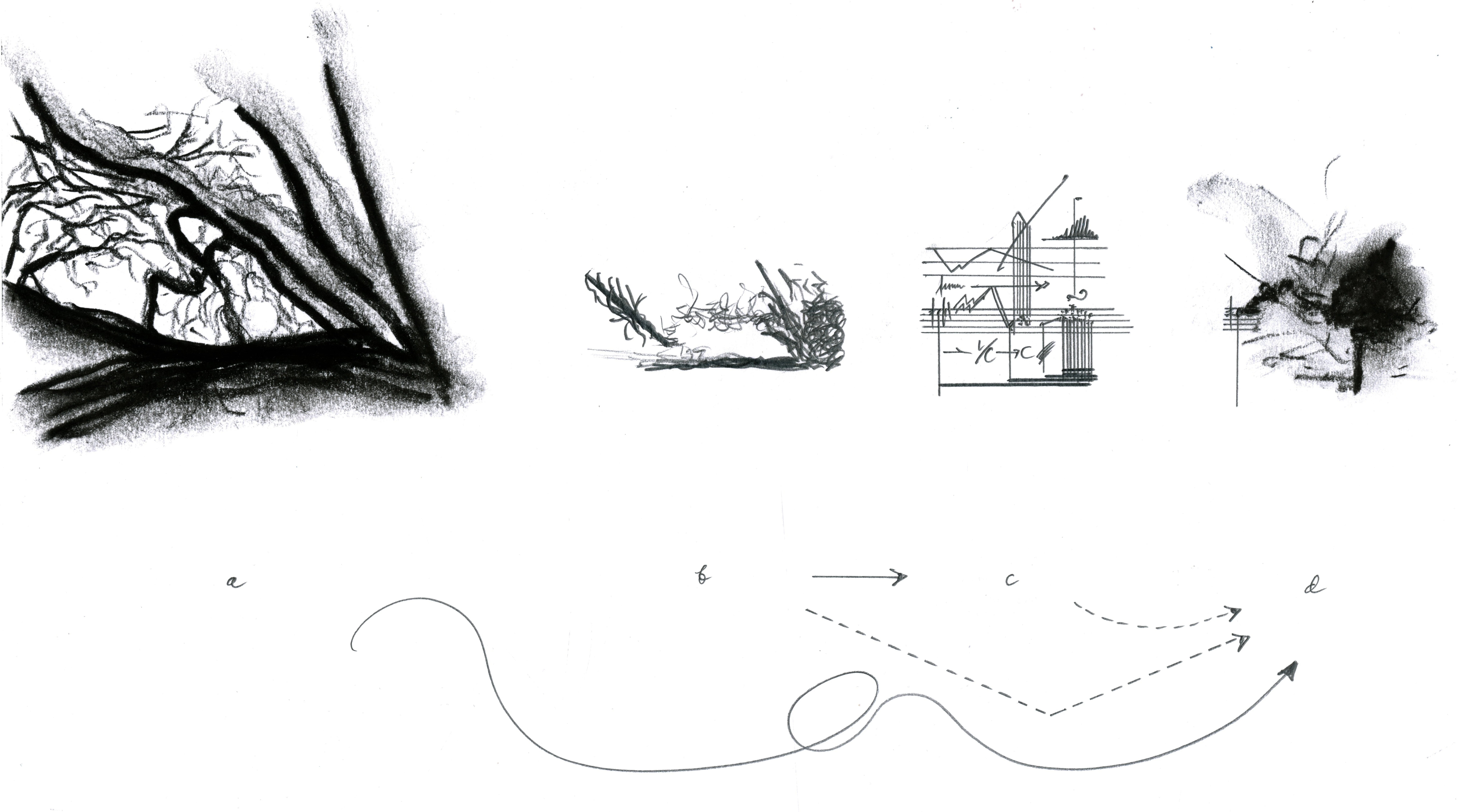
ADSR Zine 018: notations. This is a short and visually rich series of statements about my notation practice, navigating the sketch and raw pencilled impulse to eventual rendered scores. This was published in May, 2023 and I sincerely thank James Hazel and Elia Bosshard for their support and ideas.
CeReNeM Journal, issue eight. In mid 2022, I put my hand up to take on the next issue of our postgraduate journal at CeReNeM, University of Huddersfield. The previous issue, edited by Colin Frank, was published in 2020, and focused upon performing stuff, object agency, the transdisciplinary, and human-entity interactions. Given the recent Covid-19 pandemic, a worsening political landscape and climate crisis, huge leaps in AI and ecological understandings, and more locally, a struggling Brexit UK, I decided to focus upon the idea of post-, afterness-, or beyondness- as an open invitation for reflection, discussion, images, and writings. Almost 15 months later, with so many lovely conversations with friends and colleagues within artistic research and a steep InDesign learning curve, issue eight is out! With contributors from the UK, USA, Canada, Australia, Russia, Italy, and France, this issue focuses upon ideas of afterness, the post-human, AI, the audient, queer and femme timbre, collage-making, space, exile, mapping, corpus, movement, and improvisation.
Context No. 49 (2023): Navigating a Two-dimensional Field / across the plane This is my first peer-reviewed article, published in the University of Melbourne’s journal for music research Context. This article discusses my recent piano work Fourteen transcriptions from across the plane [plain] (2023) and it’s novel x-y axis notation. The article begins with:
Composing for the piano is beset by constant compromise. As a composer whose musical language is exemplified by glissandi, microtones, timbral transformation, and states of destabilisation and distortion, the piano—at least traditionally focused upon the keyboard—invokes feelings of frustration and constriction.
***
What might a notation that captures the entirety of the piano look like? It would need to capture the materials of the instrument’s body, the entire length of the strings, the mechanism of the keys, the hammers, the dampers, and include allowances for preparations. It would need to decentralise the keyboard without completely abandoning it as a parameter. A notation and lens that, at least for my own needs, allows for the possibility to destabilise and distort pitch, timbral transformation, manipulations of the strings, and invites new ways for thinking about piano technique.
Cultures of Sound, Temporary Contemporary Vol 3: Graphic and Graphite. This is my first book chapter, published by the University of Huddersfield Press as part of its annual ‘cultures of…’ series which includes concerts, talks, exhibitions, installations, workshops, community events, and publications. My essay builds upon the aforementioned ADSR Zine piece, and details the symbiotic relationship between the initial sketch and the final score…
…one that embraces the initial graphical representation of sound, free from a specific notational model, one raw, expressive, and immediate, capturing a multitude of musical parameters into a coherent and simple rendering.
Alongside these were a number of interviews appearing in:
Last Sunday, the 3rd of December, I had the honour to speak with Ian Parsons and Hamish Upton on PBS 106.7 FM where my works were played in a special radio feature. Thank you so much to Ian Parsons for this and to all the musicians and recording artists who granted me permission to share these. You can listen to the whole show here, where we speak about practice, scores, the baroque, collaboration, influences, and the Ossicle Duo + Rubiks Collective concert featuring my work Displaced Bodies, Weapons of Action…
Featured on the programme are the following works:
Two excerpts from Through Gates Unseen (2022/23) by the London Philharmonic Orchestra and musicians on its Foyle Future Firsts development programme.
concordia [temporum] (2022) by Alex Raineri (piano), Lina Andonovska (flutes), Luke Carbon (clarinets), Sonia Wilson (violin), Alexina Hawkins (viola), Oliver Russell (cello), recorded by Jai Farrell.
TOR (2022) by the ELISION Ensemble, recorded by Alistair McLean.
Procession (2023) by the Zöllner-Roche Duo, recorded by Joe Christman.
Passacaglia (2021) by the International Contemporary Ensemble, recorded by Maciej Lewandowski.
Aposiopesis (2017) by the BRON Saxophone Quartet.
Subdue (2019-20) by the ELISION Ensemble/Carl Rosman, recorded by Adam Asnan and edited by Alistair McLean.
Dust, Dew (2018) by Cikada, recorded by Pieter Snapper.
Returning to a moody Melbourne in late 2023 for Displaced Bodies, Melbourne Recital Centre.
Earlier this year I had the immense privilege to have my latest orchestral work premiered by the London Philharmonic Orchestra (LPO). This was part of the LPO’s 2022/23 Young Composer’s Programme with composer/conductor Brett Dean.
This programme included individual lessons, workshops, group seminars, professional development, concerts, all culminating in a new work written for the LPO and Foyle Future Firsts to be premiered at the Southbank Centre’s Queen Elizabeth Hall.
Premiere with the London Philharmonic Orchestra 13th of July, 2023, Queen Elizabeth Hall, London UK. Left to right, Zakiya Leeming, Jakob Bragg, Tayla-Leigh Payne, Matt London, Philip Dutton.
A little about the work:
Through Gates Unseen
A ceremony, a passage, a rite.
The ‘staff’, violently shaken, raised, swayed, and slammed back down provides the catalyst for much of the activities enacted by this vast congregation. Low drones smear and collide with each other, brass choirs amplify the entrance of towering blocks, drums with harp and oboe awkwardly dance, the viola laments, the cello responds, echoes of bassoons and bass clarinets shadow the intensity while the ‘staff’ reasserts itself for a final solo of ecstasy.
Through Gates Unseen takes Australian artist and descendent of the Yawuru people Robert Andrew’s Tracing inscription (2020) as a departure point to explore the dialogue between control and decay. Andrew’s work uses suspended charcoal, branches, ochre, and stones, each connected to a moving plotting machine at the far end of the gallery space. Over time, the plotting machine and suspended strings gradually move each piece of organic matter, slowly marking the white wall behind, smearing, decaying, breaking apart, and bumping into each other. Through Gates Unseen translates the plotting machine into a custom built percussion ‘staff’ as a force that dictates the unfolding of music activity. Sheer blocks of sound echo the separated but interdependent panels of charcoal and branches that gradually erode over time, while the smearing of line and ornamentation resemble the blurred black and ochre shadow left by the organic material upon the white gallery wall behind.
Below is the introduction that was pre-recorded for the opening of the concert with some footage of Robert Andrew’s incredible Tracing inscription.
Thank you to the members of both the LPO and Foyle Future Firsts, especially Martin Wray and Chris Vettraino for their stunning solos, Karen Hutt for her openness to my percussion ideas, to Brett Dean, Lowri Davies, and Talia Lash for making the whole process so smooth and trouble free, to my colleague Colin Frank for building ‘the staff’ so central to the concept of this piece, and to my mentors Aaron Cassidy, Bryn Harrison, and Mary Bellamy for supporting the development of this work mid-PhD.
LPO Young Composers 2022-23 Jakob Bragg, Philip Dutton, Matt London, Zakiya Leeming, Tayla-Leigh Payne
I am excited and deeply honoured to be a part of the London Philharmonic Orchestra’s Young Composer Programme for 2022-23. This marks a daunting but eager return to the unique world of the orchestra as a mass, an entity, an institution, and as a cultural product. My last orchestral work was written in 2016 for the Melbourne Symphony Orchestra and the postgrad orchestral reading session as part of my Masters at the University of Melbourne. That work, a hodgepodge of timbres, forms, and ideas, was composed first and foremost as a workshop piece rather than a concert work. It allowed me to experiment with some of my chamber music ideas I was working on at the time with orchestral forces and see how well the tactility, malleability and virtuosity of gestures stood up. This new work will allow me to finally return to those lessons and create a new concert work for a 30 piece orchestra, building upon some of the rather unique try-out sessions and workshops we have within this programme (I’m looking at you Contrabassoon!). Alongside my four other colleagues, Philip Dutton, Zakiya Leeming, Matt London, and Tayla-Leigh Payne, we will work with a combination of the Foyle Future Firsts (young artists) and members or the London Philharmonic Orchestra, mentored by composer Brett Dean throughout. The final works will be premiered in mid-July 2023 at the Southbank Centre, Queen Elizabeth Hall. More trips to London coming…
The following is a short description of my work with CeReNeM’s visiting artists-in-residence. In 2021-22 this was a virtual residency with ELISION (AU).
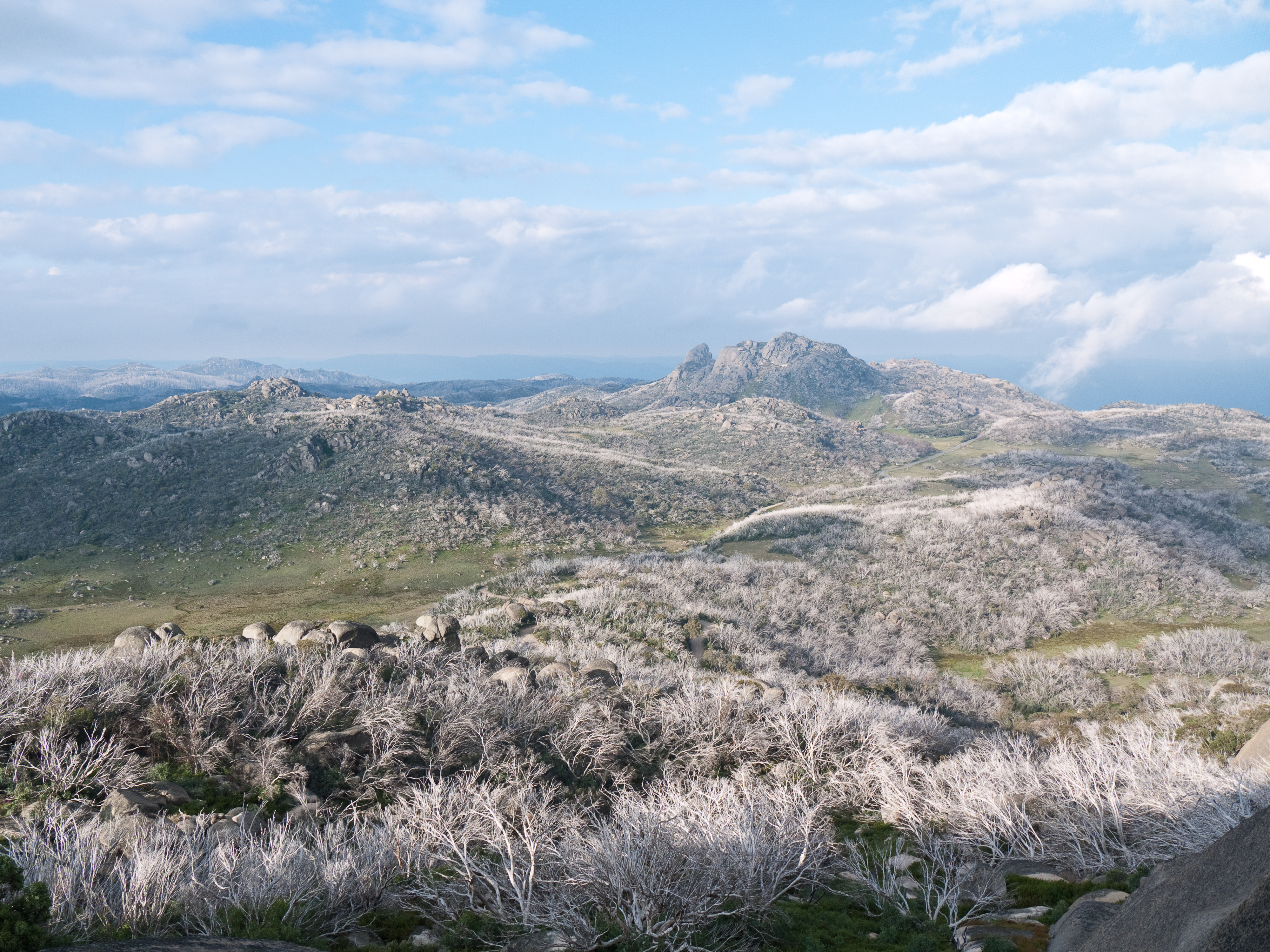
The 2021-22 academic year was split between two major milestones: one, my relocation from Melbourne (AU) to Huddersfield (UK); and two, the writing of an eighteen-minute work for the ELISION ensemble, beginning at the end with a double recorder cadenza (the video of which is available at the end of this post). Consisting seven sections, the seventh being further split into two, and confusingly the fourth and fifth sharing the same name, Tor is a work chopped, blocked, divided, with extractable sections that explore an unseen, perhaps offstage, ceremony. The title, Tor, refers to the geological formation of exposed rock often crowning peaks and hills1, most strikingly seen in moorlands and highlands. For myself, it was the otherworldly and ancient landscape atop Mount Buffalo2 that conjured such sound images and ideas about what this work could become (see image below).
Mount Buffalo in Victoria, Australia. (see image credit in endnotes)
Included within the score is the following short note:
Rising abruptly from the landscape, sheer, imposing, and breathtaking. These exposures of bedrock, weathered, crowning mountain tops, reveal a primordial earth; cultures, societies, and civilizations that revel in the Tor’s shadow are but a moment in their ever-watching eyes.
The ensemble enacts a ceremony.
Composed for the formidable members of ELISION, the Tor includes Ryan Williams on recorders (alto, tenor, basset), Paula Rae and Eliza Shephard on flutes (piccolo, C, alto, bass), Aditya Ryan Bhat on percussion (gongs, china cymbals, tenor and bass drums), Freya Schack-Arnott on cello, and Peter Neville conducting. All performers also play den-den daiko drums or ratchets. Premiered in May (2022) the work currently remains in a state of revision3, as such, I’ll focus on the last three minutes of the work, an extractable but also penultimate solo for two recorders titled Cadenza (a sub section of the seventh section Granite). For greater context, the sections of Tor are as follows:
I – Overture II – Convergence (can be extracted as a stand-alone work) III – Magma IV – Weathered (a) V – Weathered (b) VI – Plateau VII – Granite (can be extracted as a stand-alone work with the cadenza) …Cadenza (can be extracted as a stand-alone work)
Although my intentions were to create a large, multi-sectional work, a sort of battle of dominance between the two flutes and recorder as ritualistic blocks and solos, savage percussion interruptions, and extreme contrasts in mood comprise the work, the final Cadenza functions as a stand-alone miniature, complimenting my previous short work Passacaglia.
A highly personalised work, the Cadenza, is dedicated and written specifically for my friend, performer, composer, improvisor, researcher, recorder virtuoso Ryan Williams. Very early on in our conversation over the work was a discussion on the use of two simultaneous recorders. This began with an exploration of Ryan’s extensive collection of instruments from the tiny sopranino to the giant Paetzold contrabass, from modern to renaissance style instruments, and various available tunings in A440, A415, and A392. Largely informed by the register of the opening dyad, I selected the Alto and Tenor recorders to ensure good projection of volume (with control of dynamics rather limited upon recorders, almost entirely determined by the register of the given note) and the Ganassi model which in addition to having a stunningly unique tone quality has a degree of greater flexibility of pitch due to the large holes on these instruments4. Despite having worked quite extensively with Ryan before5 the negotiation of simultaneous recorders required a multitude of new considerations including the reach of the fingers (with only one hand available on each instrument), the limited pitch options available, the practicalities of splitting air (and therefore some projection) between two instruments within the mouth, moving between instruments, and eventually novel solutions including stopping an instrument on the knee. Each of these required numerous demonstrations, one where energy and dedication is required from both to create a work that is (hopefully) mutually fulfilling; a showcase for both the performer and composer alike.
Figure 1
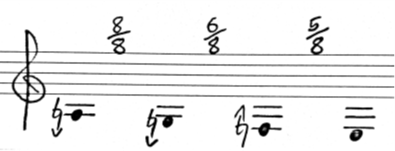
Aside from frequent video sessions (Ryan being in Australia, myself in the UK) and the back and forth of short question and answer audio messages, the act of writing materials was always in close reference to the fingering chart Ryan provided with all the possible pitches available with one hand (see Figure 1). This ensured that I could ‘play’ through my own materials (utilising two timber rulers to substitute the recorders) checking the ofttimes awkward finger combinations, especially when half-holes are required. This chart naturally informed my pitch selections with a number of pitches completely unavailable, most notably in the lower half of the second register.
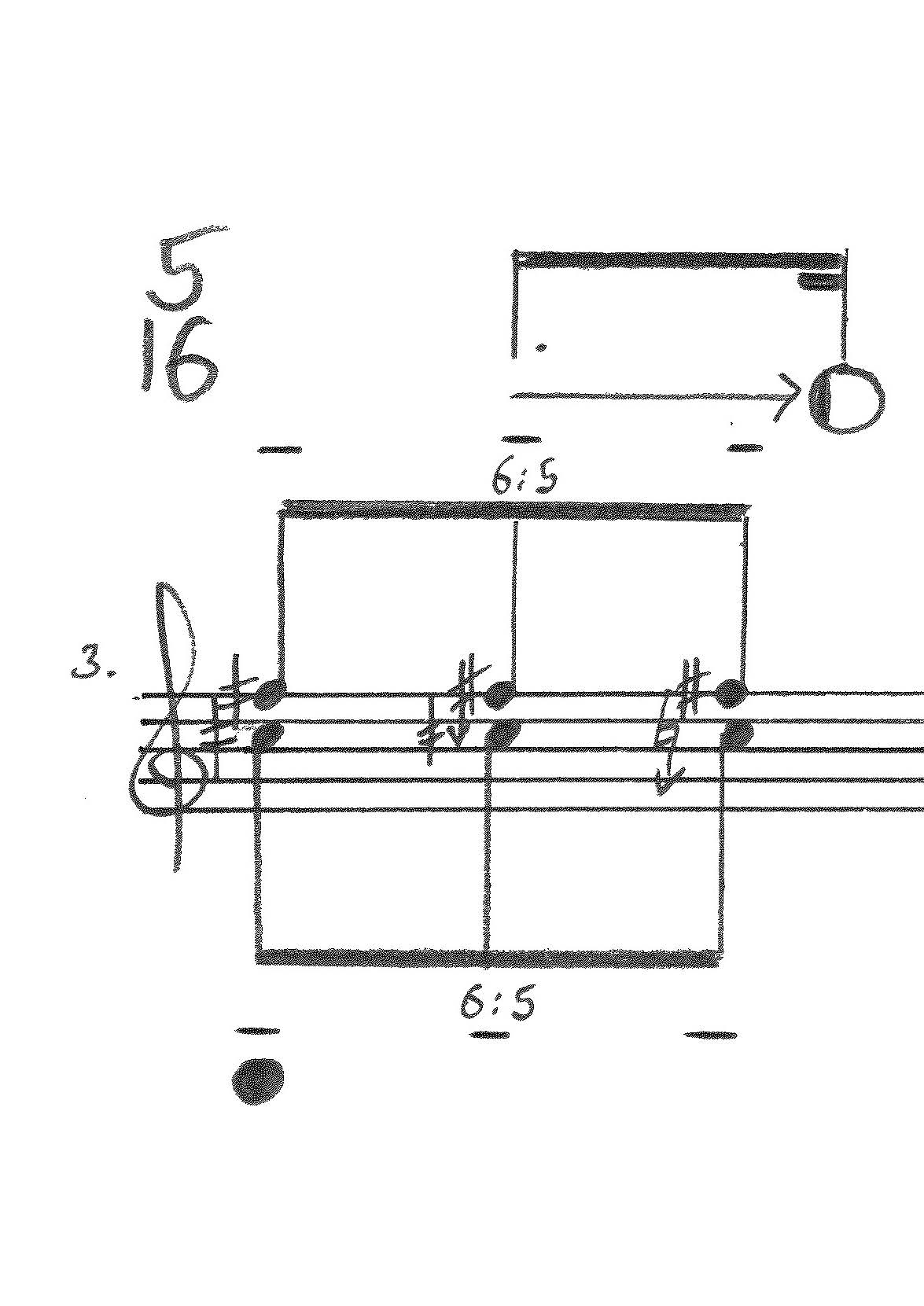
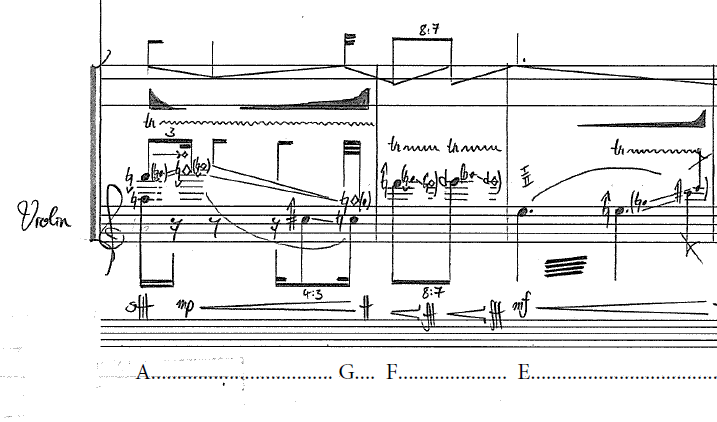
Listening to some of the existing repertoire for double recorders such as Louis Andriessen’s Ende, Maki Ishii’s Black Intention, and Moritz Eggert’s Außer Atem, it began clear that the sound world I envisioned was markedly different to the more repetitive, somewhat locked-similar motion, hocket-like patterns that these works explored. Like the combat between the flutes and recorder in the earlier ensemble sections of this work, I wanted the recorder cadenza to overtly asserts itself; the cadenza functioning as the penultimate moment where the recorders mimic and claim dominance over the double flutes. As a result, two primary behaviours emerge within the three-minute composition: 1) assertive and locked-together, dyadic behaviours, and 2) fluid, morphing, irregular materials. In the first, it’s clear that both recorders are equals, regardless of whether they are uniting together or fighting each other for dominance, both remain locked together. This is evident with the repeated fourths (of varying microtonal deviation), unison sections and similar motions moments (see Figure 2). The second behaviour, rarer, is exemplified where only one recorder is used, in addition to the use of messy, heterophonic materials and where one recorder deviates from the other (see Figure 3). A potential third and more ambiguous material is the use of the voice. Is the voice a third recorder? Is the voice the distant echo of the flutes from the previous ensemble section? Is the voice an amplification of the dominant recorder at each given moment? I am still unsure and depending on if you ask me today or tomorrow my answer will be different. I believe the voice functions as all three depending on how one receives the work, how the performer executes the work, and how one interprets the sheer, almost helpless cry, of these intense assertive moments of instrument and voice.
Figure 2Figure 3
Formally, the progression of material largely follows an organic process of extrapolation, where a dyad of growing instability is repeated, varied, begins to melt away or even collapse, before a messy assemblage attempts to reassert a new dominance. This occurs six times, with each reiteration a different duration and each returning assemblage becoming less stable. This number, in addition to the length of each process, is a product of audiation; ultimately an internal and imaginative listening and performing of the materials until the result is satisfactory to my own taste6. The use of controlled leakage of air, overblowing, vibrato, flutter tongue, and the voice all add certain amounts of distortion to this progression in addition to contributing to the ornamental, densely layered, and chaotic moments as collapse and rebuilding occurs.
Figure 4
In scoring, this work has followed a number of recent experiments into how I communicate sonic ideas, structures, character and mood, and the dialogue between score and interpreter (read composer and performer). For much of Tor, I used a blank page granting me the freedom to use the five-line stave as irregularly as I like, removing it entirely wherever appropriate. This also allowed for more novel experiments in notation such as a re-prioritisation of parameters, a re-organisation of layers, and allowing for moments where gesture and shape become the focus. As an avid drawer (mostly using pencil and charcoal), I have attempted to marry my sketching and compositional practices a little more, adopting visual and hand drawn representations of materials which are further enhanced by the filtering out of the five-line stave, communicating a much more creative freedom for Ryan and any other performer (see Figure 4). Enhancing this further is the use of rhythm and meter. There is a dialogue between open duration moments and those locked into strict tempo and rhythm. Perhaps in reverse to the listeners expectations, the assertive dyadic materials are mostly open in duration with the drawing of line, from minor bump to erratic zigzags, illustrating length and potential envelope7, whereas fluid and irregular materials are meticulously notated. This accentuates the distinction between the two behaviours I discussed earlier and allows for both conventional8 notation to inform the abstract notation, and abstract notation to inform the conventional notation.
Lastly, I want to briefly address a term I used earlier – that of a personalised work. As Bellamy points out in her article Developing instrumental sound resources through collaborative compositional practice (2013)9 “collaborations between composers and performers are by nature a highly personalised experience”, ideally one where an “open exchange” can occur between all participants. My own experience in collaboration very much echoes this however I’d like to take it to another level. Where a deep friendship develops between collaborators there can arise a deeper personal layer to a work. This can take many forms including the referencing or quotation of in-jokes, creating materials that directly respond to a shared personal experience, a greater level of trust and honestly when working through difficult materials, an awareness of previous artistic work (this could include avoiding pitfalls from previously failed collaborations or building upon successful ones), an awareness of non-musical and personal interests, and even the potential creation of a sort of ‘metamusic’ where one references or takes inspiration from the others work, which was itself derived from the original persons previous work. It is elements such as these that make the collaboration between myself and Ryan personalised. The result is a work that saw so much of the musical materials shaped, altered, fixed, and enhanced by a close working relationship and trust where musical ideas are not just allowed to walk, but to run.
A huge thank you to CeReNeM and the University of Huddersfield, ELISION ensemble, Ryan Williams, Alistair McLean (sound), Agatha Yim (video), and Kris Chainey (lighting).
Enjoy…
References
Image credit: Olah, Z. (2010). Mt buffalo plateau [Image]. Wikimedia Commons. https://commons.wikimedia.org/wiki/File:Mt_buffalo_plateau.jpg 1 Britannica, Editors of Encyclopaedia. (2021). Tor. Encyclopedia Britannica. https://www.britannica.com/science/tor-geology 2 There is still much ongoing research as to the indigenous custodians of the Mount Buffalo area. Currently the Taungurung are the registered aboriginal party of this area, with the Buffalo river valley considered part of the Mogullumbidj nation during early colonisation. See Durrant, J. (2019). Mysterious Mogullumbidj: First People of Mount Buffalo. Life on Spring Creek. https://lifeonspringcreek.com/2019/12/15/mogullumbidj-first-people-of-mount-buffalo/. Unfortunately, I cannot find any reliable source of the indigenous name(s) of the mountain at this stage. 3 Unfortunately, an all too familiar combination of anxiety, perfectionism, doubt, and hope form a post-premiere crucible, independent of ELISION’s masterful performance. 4 Larger holes allow for easier and greater control of microtones which require quarter, half, or three-quarter leaking. For more information on the Ganassi recorder see Brown, A. (2006). The Ganassi recorder: separating fact from fiction in American Recorder, November 2006, 11-18. Brown has a link to his article available on his website here: https://adrianbrown.org/ganassi-recorders/ 5 See my work for the Horsley & Williams Duo Between Giants (2018). 6 Audiation, at least for myself, can be a tiresome and lengthy process of filtering musical material and determining much of my pitch and rhythmic content. For further reading on audiation see the journal Principle of music composition XVIII, in particular: Herck, B.V. (2018). Audiation: What to Listen for? in Principles of music composing XVIII, 2018(18), 9-17. http://xn--urnalai-cxb.lmta.lt/en/issue/muzikos-komponavimo-principai-xviii-nuo-audijavimo-link-komponavimo/ 7 I use the word potential to indicate an openness as to how the visual score element can be interpreted. It can be a rather direct mapping of the visual to a sonic. Alternatively, it could be an indication of intention or state of mind. 8 I use the term conventional notation to describe the score elements of beamed rhythms, time signatures, western pitch notation, articulation markings etc. A want to avoid the term detailed as I consider the more visual and abstract notation elements to be just as detailed and informative. 9 Bellamy, M. (2013). Developing instrumental sound resources through collaborative compositional practice in Journal for New Music and Culture, 2013(10). http://eprints.hud.ac.uk/id/eprint/18915/
The following is a short description of my work with CeReNeM’s visiting artists-in-residence. In 2020-21 this was a virtual residency with International Contemporary Ensemble (USA) as part of the Re.Co.Lab programme.
One of the major projects for the first year of my PhD at the University of Huddersfield and a vital work in returning to composition post-lockdown was Passacaglia. Composed for Josh Modney (violin) and Levy Lorenzo (percussion) of the International Contemporary Ensemble (IntCE), I began writing in early 2021, with workshops and rehearsals in May through to June and the resultant video recording occurring not long after (see end of this post).
It’s hard to describe just how important this work was in returning to productive workflow, having struggled to engage in any creative work or practice during the various lockdowns in Australia (the last of which ended in October in 2021). This was an incredible opportunity to work with the fierce advocates for new music that is the renowned IntCE, but also a project that provided much needed excitement and motivation during the second year of the pandemic. I don’t want to belittle the other fortunate opportunities I had during the years of 2020 and 2021, but I found this opportunity particularly pronounced as my first work written for CeReNeM, which included a certain feeling of comradery with my fellow researchers and artists as we strive to create music in such trying times. Lastly, and most pertinent to my studies, this work really began the line of questioning and investigation intrinsically linked to my PhD.
I bring up these sentiments as they were key in how I began the composing of this work. Attempting to reignite the flame of composition, I began with the music I had been listening to at the time: solos and small works of the baroque period. Choosing the much-loved Passacaglia from Heinrich Ignaz Franz Biber’s Rosary Sonatas, I began an investigation into the passacaglia as a form and what I loved so much about this work. This manifested into a list of generalised assumptions and characteristics of Biber’s Passacaglia (and of most other works within this form) that include:
Repetition: often of four pitch-based events taking the form of a bass line. I use the term events to describe something that could be more abstract and less confined to specifics such as a melodic or bass line.
Descent: often pitch based, with harmonic, melodic and rhythmic materials working in conjunction or in close relation to this movement.
Closure: the nature of small-scale structures (often tied to the bass line) coming to a close, providing a regular punctuation-like point throughout the work. This manifests in a variety of forms including the compression of intervals, a certain resolution of rhythmic activity, and dynamics that further amplify this.
Variation and expansion: the gradual development of activity and detail as the work unfolds. This includes a greater exploration in range, volume, intensity, ornamentation, and virtuosity.
Biber’s Passacaglia from the Rosary Sonatas
It was here that I found the required compositional seed that could grow into a fully formed work. How could each of these characteristics, each of the component parts of the passacaglia, and even the original Biber passacaglia itself, go through a process of abstraction and distortion.
Largely this was via an exploration of extremes, an amplification of each of these components to the point of reaching an almost uncanny state. The resultant work goes through various stages of filtering, beginning with saturated and virtuosic gestural material before being quickly reduced to simple sustained gestures. This process occurs four times with the filtering down taking place over a similar but not identical duration, resulting in distinct block-like structures that make up the overall shape of the work.
Composed for a duo of violin and percussion, I wanted to maintain a raw and even austere quality between these two instruments, favouring a very simple percussion set-up to compliment the solo violin. The percussion, a lonely frame drum with a few stones (in the recording sandpaper and stone is used instead) often mirrors the violin, accentuating certain gestures such as vertical bow movement, scratch tones, long sul tasto tones, trills, glissandi, and dominant pitch points. Occasionally the drum will attempt to assert itself with Sarabande-like rhythmic figures, often widely out of sync with the violin, resulting in a fiercer battle between the two instruments; perhaps not unlike the use of runaway scalic figures that attempt to loosen themselves from the shackles of the grounded bass in Biber’s Passacaglia. With regards to the violin, the fourth string is detuned to an E3 and the second string down by an eighth-tone. In addition to a bow position stave, the violinist must often negotiate between two pitch staves, one a typical 5-line stave and the other an indeterminate pitch parameter indicating the highest and lowest position available on the fingerboard. It is within this parameter that shadows of the original Biber are mapped with figures tracing the contour, direction, and rhythmic detail of certain direct quotations.
Coming back to my original list of characteristics, the first and last were maintained and even enhanced ensuring some resemblance to the passacaglia form I attempting to reference. The concept of closure (the third in my list) is either non-existent in the dense virtuosic sections or incredible obvious as the filtering-out begins to take place. Instead of dynamics working in conjunction with the closure of phrases, my use of dynamics are reverse-engineered, broadly featuring crescendo-like figures propelling the momentum forward or going to another extreme, utilising extremely soft and static-like dynamics. Variation and expansion (the fourth in my list) occurs at an extreme level. Layered are both ornamental figures and different performance-based parameters (e.g. bow position, scratch tone etc) which amplify the concept of variation into the extreme. This is further enhanced with the use of quotations from the original Biber passacaglia, made unrecognisable with their appearance only occurring as indeterminate pitch.
Figure 1
Although disguised via dense textures and levels of distortion via bow pressure and bow position, the repetition of an underlying pitch-based event is central to this work. Seen in Figure 1, these four descending pitches form an anchor-like constant for the violin throughout the entire work. Never uniform in their duration, these pitches always appear in the same order before the cycle begins again. The first three bars of Passacaglia demonstrate this as seen in Figure 2, where each pitch event is either referenced, provided as a sense of grounding, or used as a catalyst for expansion. Their identity is intentionally masked in the dense layered sections, with the indeterminate pitch stave often providing further abstraction, while their pitch content is made somewhat clearer (albeit still masked or transformed in some way through the use of harmonics, sul tasto, col legno etc) in the responding sparse sections.
Figure 2
In working with Josh Modney, I had originally envisioned to create my work for gut strings and baroque bow, an obvious nod to the baroque inspiration, but after a discussion on achieving maximum control and dynamic variation we elected to retain a modern violin setup. I’ll also add the Josh’s performance and composition skill on his CD Engage (2018) was of huge inspiration, especially in the pre-composition stage before deciding to use Biber’s Passacaglia as a catalyst for this work. I encourage a listen to Modney’s just intonation performance of J.S. Bach’s Violin Partita No.2 (BWV 1004: V) and his own work Pastoral; a hauntingly still work of warped dyads and unsettled harmonies.
A huge thank you to CeReNeM and the University of Huddersfield, the International Contemporary Ensemble (especially Josh Modney and Levy Lorenzo), and Nicholas Houfek, Ross Karre, Felipe Wurst, and Maciej Lewandowski who supported this project and helped create the stunning recording and video available here.
After a little over 6 years living in Melbourne, I now say a sad goodbye to my diverse, arts loving, coffee drinking, laneway and graffiti littered, changeable city. The past 6 and so years have been absolutely wild. With the Covid-19 pandemic, the 2019-20 Black Summer bushfires, the completion of my Masters, the commencement of my PhD in the UK remotely (including some 2-4am classes), new artistic and personal relationships forged, some 17 new compositions, and teaching well over 70 students across universities, primary schools, and privately, there is a sense that the last six years round out another important and rather intense chapter centred upon Melbourne. Reflecting on my experience living here, I can’t help but indulge in some sentimental reminiscing, one I hope you will indulge me with.
For me, Melbourne is…
…experimental improv at Make It Up Club (a shop-front attic in Fitzroy), monthly ELISION concerts at the Brunswick Green pub, finding the next hidden location for Speak Percussion’s Before Nightfall project, free concerts at the Melbourne Conservatorium’s New Music Studio, New Music Classics at the old Elsternwick Cinema, the Local Heroes series at the Melbourne Recital Centre, concerts at the Abbotsford Convent, new music festivals including Homophonic (“celebrating 10 years of mind bending queer classical music”), Tilde, Metropolis; the annual pilgrimage to Bendigo for BIFEM (Bendigo International Festival of Exploratory Music), spending hours in ACCA (Australian Centre for Contemporary Art), NGV (National Gallery of Victoria), drinking my way through the 100s of wine bars scattered across the city, rooftop bars in summer, underground bars in winter, jumping on a tram in a 40 degree heatwave only to jump off 20 minutes late and find it’s now raining and 19 degrees, Autumn leaves, Spring flowers (for my international friends, most of Australia doesn’t get the ‘4-seasons’), knowing (and ranking) every different model of tram on the network, everywhere just doing such damn good coffee, cosy neighbourhood pubs, the East-end theatres, community theatre in Alma Park, the grand Victorian buildings of Collins Street, the brick factories of Richmond, hipster Fitzroy and Collingwood, Californian St Kilda and Beaconsfield Parade, the lush, misty, Mountain Ash covered Dandenong Ranges, snow-capped Victorian Alps, and my quaint little corner of Balaclava.
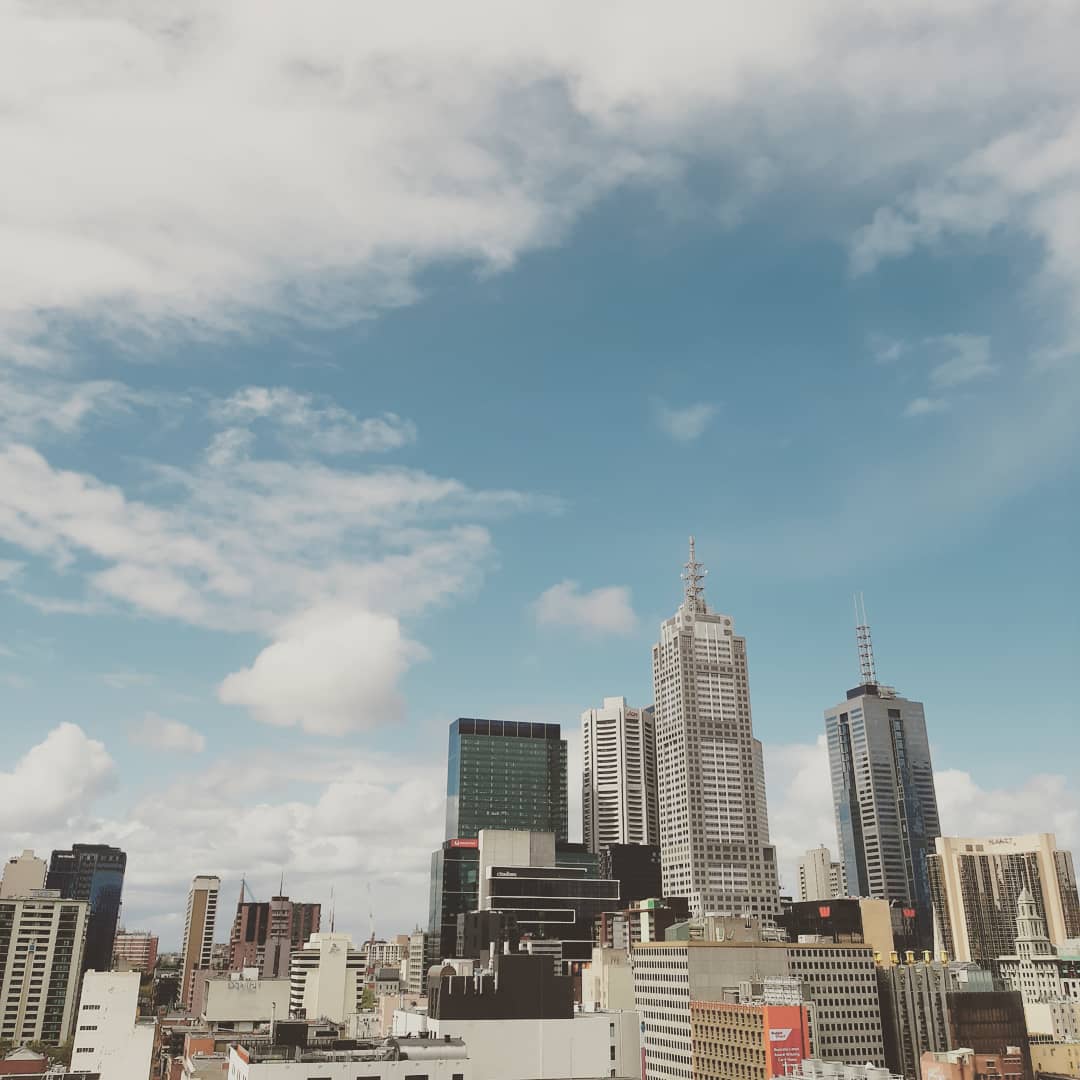
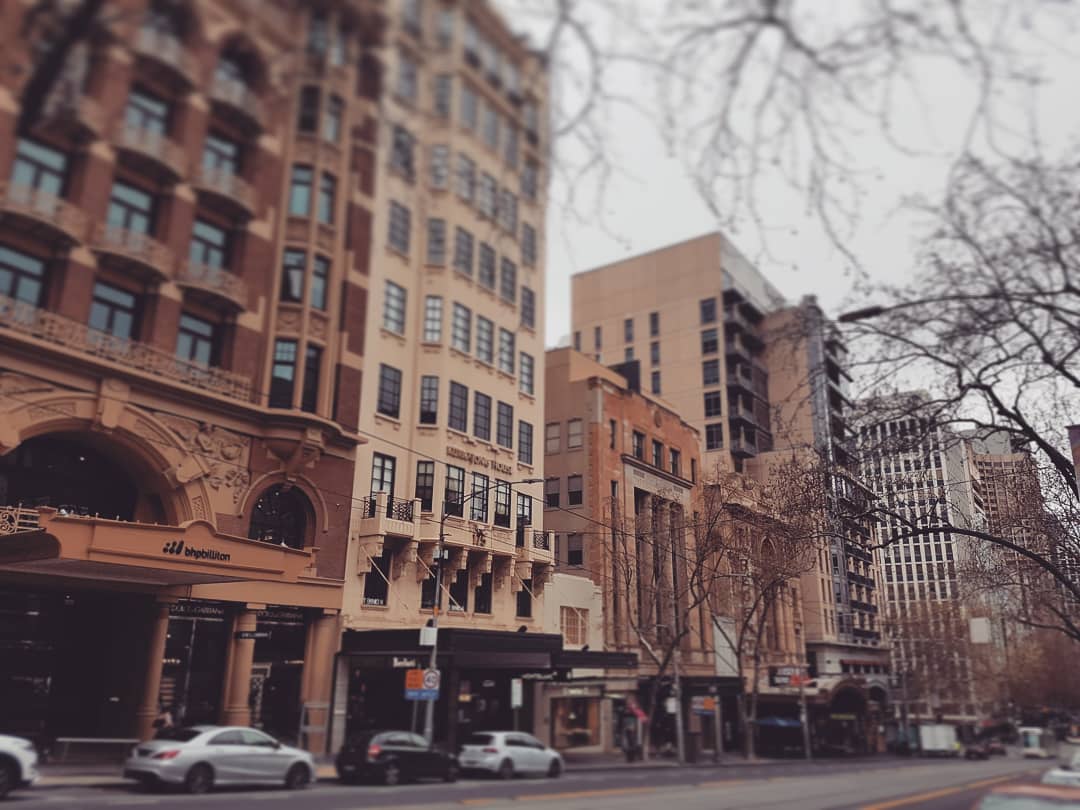
Melbourne city in Spring (left), Collins Street (top right), Balaclava (bottom right)
…
Melbourne marked some crucial developments in my composition education and development. I began seeking lessons and developed on-going mentor relationship with Liza Lim, completed my Masters of Music in Composition with Elliott Gyger at the University of Melbourne, had the fortune (and crucial financial support) to undertake various composer summer schools, both abroad and locally, and developed new artistic relationships with ELISION, Ryan Williams, Phoebe Green, Callum G’Froerer, Ossicle Duo (Benjamin Anderson and Hamish Upton), Rubiks Collective, and many others. In particular, the University of Melbourne has provided an invaluable amount of support, through performance and workshop opportunities (Song Company, Melbourne Symphony Orchestra), commissions/prizes (the Melbourne Recital Centre prize), and through a host of funding opportunities including support for my 2017 Impuls Academie trip, 2018 Darmstadt and Voix Nouvelles Royaumont trip, and two generous scholarships that are helping to fund my current PhD in the UK (Rae and Edith Bennett Travelling Scholarship and the Welsford Smithers Memorial Scholarship). Without this support and these opportunities (as well as the aforementioned teachers and performers), I genuinely wouldn’t be where I am today.
There is so much I love about Melbourne, one that if circumstances were different would have kept me there for much, much longer, but after 16 months of remote study away from the UK, I am now able to continue my PhD in person and move to Huddersfield (UK) (having moved in January 2022). This exciting new chapter will undoubtedly be centred around the PhD and the continued evolution of my composition practice proceeding from both my research and future collaborations. So for now I say goodbye and thankyou to Melbourne and all my dear friends there and hello to Huddersfield and the UK, with the promise of much more music and writing to come!
I recently began teaching the undergraduate course Orchestration at the University of Huddersfield where I’m also undertaking my PhD in composition. The opportunity to lecture and have considerable autonomy over the coursework and repertoire has granted me the ability to make significant changes to this course. Shared between my fellow PhD candidate, Arash Yazdani, we’ve dedicated a huge amount of time into bringing a more diverse, balanced, and 20th and 21st century component into what has traditionally been a 18th and 19th century white male dominated subject. Reflecting on my own experiences studying orchestration during my Bachelor of Music, it was almost entirely dominated by the narrow and dated linage of Mozart, Haydn, and Beethoven, to Brahms, Wagner, and Mahler, ending with a little Stravinsky. In having the opportunity to retell this story, the orchestral trajectory through history, I’ve been able to include composers such as Marianna Martines and Joseph Bologne ‘Chevalier de Saint-Georges’ alongside Joseph Haydn, draw comparisons between Ethel Smyth and Benjamin Britten, illustrate early 20th century Paris using Lili Boulanger and Germaine Tailleferre, look at the conflict between soviet and modernist ideals in Galina Ustvolskaya, and illustrate a growing national identity in the American continent through composers such as Heitor Villa-Lobos, Carlos Chávez, and Florence Price.
This is my first-time teaching orchestration and undoubtedly I will constantly expand upon this repertoire, develop new ways to communicate the trajectory of the orchestral setting, and refine the threads I tie between certain composers and perspectives.
To mark International Women’s Day 2021, I wish to highlight some of the composers and their works which I’ve been able to explore in teaching Orchestration this year. This is not an exhaustive list, but a small selection of some the phenomenal female composers and their works I have covered so far:
Lili Boulanger: Psalm 130
Unsuk Chin: Šu for Sheng and Orchestra
Ruth Crawford Seeger: Music for small orchestra
Chaya Czernowin: Wintersong V – Forgotten light
Louise Farrenc: Overture in E minor, op.23
Sofia Gubaidulina: Patominime for Double Bass and Piano, and the Preludes for solo Double Bass
Liza Lim: Invisibility
(what better way to explore string techniques and timbres than through these two composers!)
Dora Pejačević: Symphony in F# minor, op.41
Julia Perry: Short piece for Orchestra
Florence Price: The Oak
Rebecca Saunders: ‘Alba’ for solo trumpet and orchestra
Ethel Smyth: The Wreckers
Germaine Tailleferre: Image for 8 instruments
Galina Ustvolskaya: Concerto for Piano, Strings, and Timpani
I recently had the pleasure to chat with the Brisbane Music Festival artistic director, Alex Raineri, on our upcoming concert: New Sounds. We discuss my new work for Alex and Kupka’s Piano, Nest of gravel, which will be premiered tonight (Oct 10th, 2020, 6pm AEST), alongside an array of topics including musical education, noise, politics in music, lockdown, and digital content in the world of Covid-19.
Nest of gravel is a rather intense exploration of highly tactile and granular sounds, with the performers movement restricted over the physical regions of the piano as the keyboard, pedal and strings rattle, scrape, and grind against each other. This confinement of movement naturally resonates with many who have experienced in lockdown. There is a sort of repetitive, agitated, claustrophobia in this work as scratching and rubbing gets under your skin. On this, I make this point:
For some, lockdown has meant resort-like living, unburdened by financial worry. For others, it has entailed police presence, cage-like confinement, and an amplification of already tenuous socio-economic conditions. The detainment of refugees, political prisoners, and minorities has been a reality of society well before 2020 and it must be remembered that what many have experienced recently is but a drop in the ocean of what systematic and weaponised confinement entails.
What legacy will 2020 leave. The year of Covid-19, society as we know it on standby, a long-held breath, strained and waiting for what will come. Will 2020 be the year in which a global coordinated effort held at bay what could have been much, much worse? Will it be the year that nations failed, society failed, and one in which millions died? Or do we see the beginning of something much larger, perhaps a dramatic shift in the way society functions, the role technology plays, the nature of political and economic discourse, or a re-evaluation of what truly is important in our blip of existence?
Maybe…
Rather than the phrase ‘time will tell’, importantly it will be ‘we that will tell’. Our actions, our response, and our choices are what will shape this and subsequent years.
…
I suppose a rather morose beginning, but naturally these events have all our minds racing.
Artistically, I’ve been in the deep end of writing, trying to complete my new work for a combined Rubiks Collective and Ossicle Duo: Displaced bodies, weapons of action. It is with sadness, but also understanding, that our scheduled concert for April 21st is postponed until further notice. This is also true for the Horsely & Williams Duo concert on March 20th, which would have seen the release of their new CD including my work Between giants. However, these concerts are merely postponed and not cancelled, so stay updated!
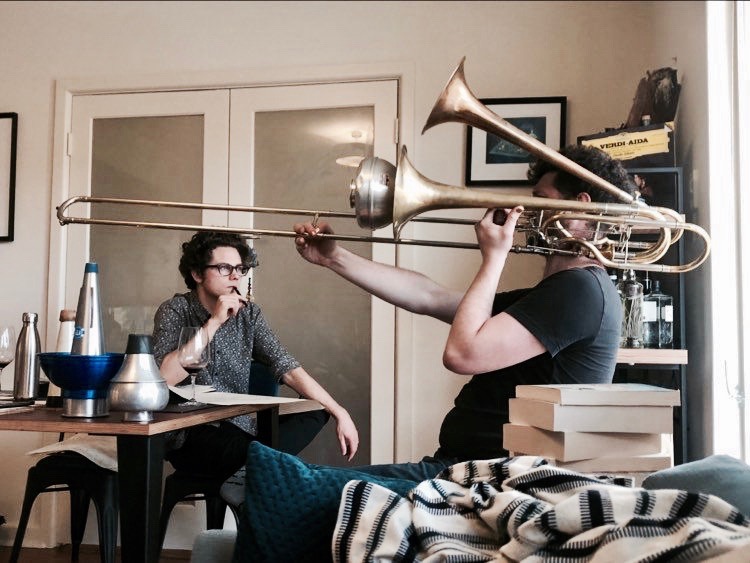
Regarding my work Displaced bodies, weapons of action, I had been in separate discussion with both Rubiks and Ossicle about a new work for some time now. I’ll add that these two ensembles represent the highest music making of young musicians in Melbourne today, both programming fascinating and inventive works with a focus on collaboration and exploratory music. It was in late 2019 that I was honoured to receive the Melbourne Recital Centre (MRC) and Melbourne Conservatorium of Music Composition Prize. This is awarded to two recent graduates of the Conservatorium resulting in a commission for one of the MRC’s Local Heroes ensembles. Through this opportunity, some negotiation, and the support of the MRC, Rubiks and Ossicle were excited to come together. The resulting concert, Praxeology, will feature a mix of their combined forces, culminating in my new 25 – 30 minute work for all six musicians. The combined instrumentation consist of flute(s), cello, keyboard(s), percussion (Rubiks), and trombone(+) with percussion (Ossicle). This is further enhanced by extensive use of Jacob Abela’s (Rubiks) Ondomo (a smaller portable version of the Ondes Martenot) and Benjamin Anderson’s (Ossicle) double-bell bass trombone. Add extensive piccolo parts, detuned cello, with an assortment of cymbals, gongs, tin cans, and drums, and this seemingly balanced line-up of wind, brass, strings, piano, and percussion starts to look and sound very alien!
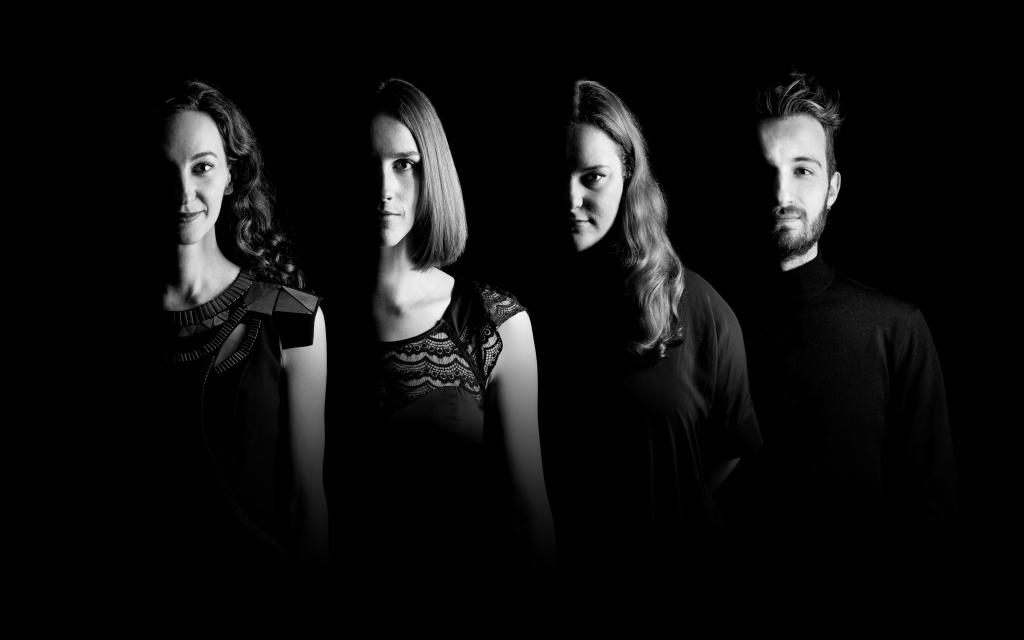
Rubiks Collective – Cameron Jamieson Photography
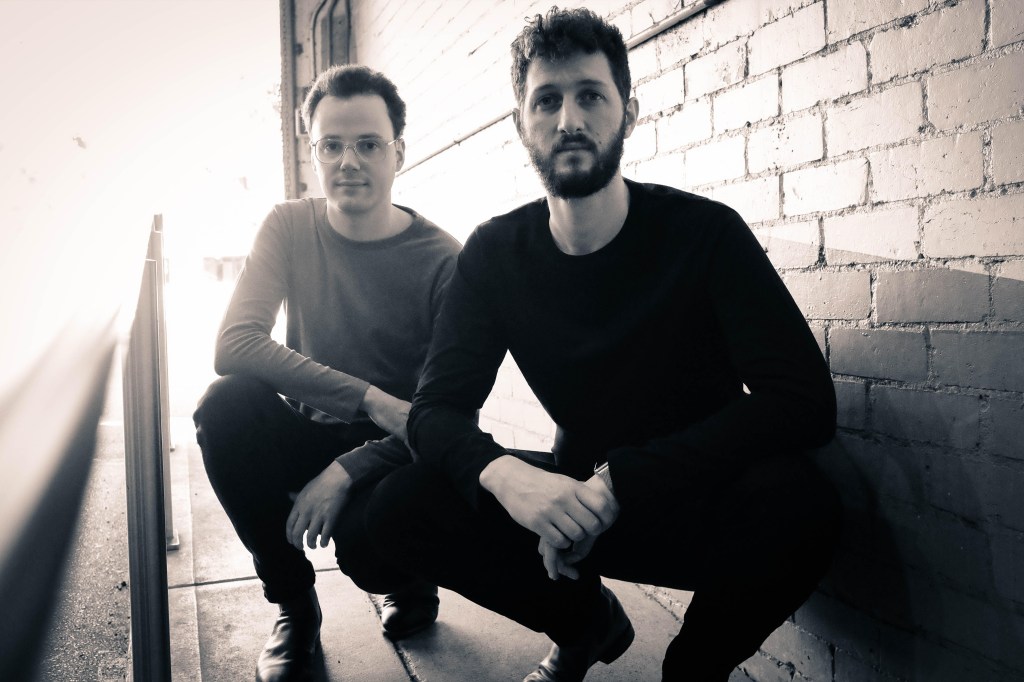
Ossicle Duo – Jon Woods Photography
The first movement is entitled opera; an absurd and excited dance between extremities in colour, range and density. Drawing obvious parallels with the international and domestic stage of politics on issues such as climate change, refugees and immigration, socio-economics, and health, opera dives haphazardly between ideas eventually culminating into a call to arms. Our lives, our very bodies, shaken, displaced, and devastated, become weapons for action and change. A raucous and militarised duo of double-bell trombone and percussion showcase Ossicle as a domineering brutal force. This crucible of sensationalism, inaction, disenfranchisement, and frustration leads to escalation; a whirling of ratchets and screaming trombone lead to an uncertain but inevitable future. In afterness, piccolo and low cello, scratching and meandering, giving way to bowed piano and bold trombone statements, alluding to an uncertain future, one where change or failure has shaped our new existence.
Workshop with Benjamin Anderson and his double-bell bass trombone







 Jakob Bragg
